You now know more about skincare than 95% of men on the planet. You understand the two aging processes. You know what collagen is and how it’s destroyed. You understand the barrier. You have the five-ingredient list.
But there’s a problem. Knowing the right ingredients isn’t enough. Using them in the wrong order, at the wrong time, or in the wrong combination can reduce their effectiveness, cause irritation, or simply waste your money.
This is the chapter the skincare industry never writes, because explaining the correct sequence makes it obvious that you only need a few products. And that’s bad for an industry built on selling you more.
Your Skin Has Two Shifts
Think of your skin as running two separate operating modes. A day shift and a night shift. Each one has a different objective, and the products you use during each shift need to match that objective.
The morning shift is defense. You’re about to spend 12–16 hours exposed to UV radiation, pollution, temperature changes, and environmental stress. Your morning routine’s job is to prepare the surface, hydrate it, and deploy protective layers that will absorb damage before it reaches your skin’s structural layers.
The night shift is repair. You’re about to spend 6–8 hours in a controlled environment with no UV exposure, no pollution, and minimal physical contact with your face. Your night routine’s job is to clean off the day’s damage, apply the ingredients that actively rebuild your skin, and seal everything in so the repair process can run uninterrupted while you sleep.
These are not interchangeable. Using your repair ingredients in the morning wastes them. Using your defense ingredients at night misses their purpose. The timing is as important as the ingredients themselves.

The Morning Stack
MORNING
Step 1: Clean → remove overnight oil and debris
Step 2: Hydrate → restore water balance with hyaluronic acid
Step 3: Defend → deploy antioxidants against UV-generated free radicals
+ SPF → block UV radiation at the source
Total time: approximately 90 seconds
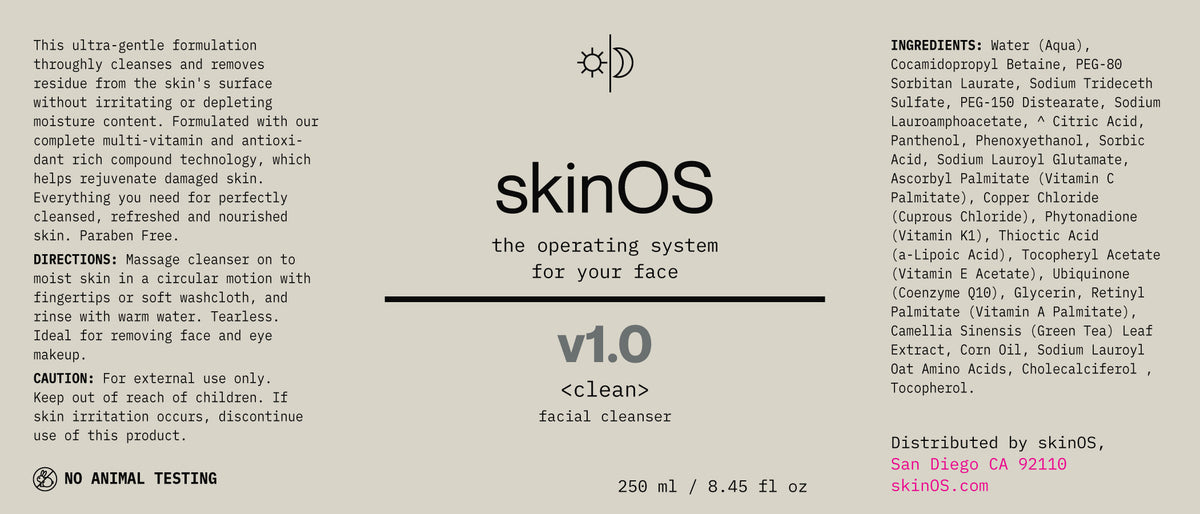
Step 1: Clean. While you slept, your skin produced sebum, shed dead cells, and accumulated debris from your pillowcase. A gentle, pH-balanced cleanser removes this layer without stripping the barrier (everything we discussed in Chapter 4). This takes about 15 seconds. Wet your face, apply the cleanser, massage briefly, rinse. Done.
Step 2: Hydrate. On clean, slightly damp skin, apply your hyaluronic acid serum. HA is most effective when applied to damp skin because it draws the surface water into the outer layers of the epidermis. This step takes about 10 seconds. Four to five drops, pat into face and neck. The hydration serum creates the base layer. Everything applied after it performs better on hydrated skin.
Step 3: Defend. Apply your antioxidant gel or serum. This is the free radical defense layer we discussed in Chapter 5. Vitamin C, vitamin E, ferulic acid, or a combination. Its job is to neutralize the reactive oxygen species that UV radiation will generate throughout the day. Apply it over the hydration layer. About 10 seconds.
+ SPF. Last layer. Mineral SPF (zinc oxide) sits on top of everything and physically deflects UV before it reaches your skin. Apply after your antioxidant layer has absorbed for a minute. If you’re using a stick format, this takes about 5 seconds.
That’s the morning. Clean, hydrate, defend, protect. Four actions. 90 seconds. You do it after you brush your teeth and before you put on a shirt. It becomes automatic within a week.
Why This Specific Order
The sequence isn’t arbitrary. It follows a principle in skincare formulation called “thinnest to thickest.”
After cleansing, you apply the most water-based, lightest-weight product first (the HA serum). It penetrates the skin because there’s nothing blocking it. Then you apply the antioxidant layer, which is slightly heavier. It sits on top of the hydration layer and creates a functional barrier of active ingredients. Then SPF, which is the heaviest and most occlusive. It sits on the surface and doesn’t need to penetrate because its job is to deflect, not absorb.
If you reverse this order, things go wrong. SPF applied first creates a physical barrier that prevents your antioxidant serum from reaching the skin. HA applied after SPF can’t penetrate the zinc oxide layer. The products interfere with each other instead of building on each other.
Thin to thick. Water-based to oil-based. Penetrating to surface-sitting. That’s the logic.

The Night Stack
NIGHT
Step 1: Clean → remove the day’s oil, debris, sunscreen, and pollution
Step 2: Rebuild → apply retinol to stimulate collagen and accelerate cell turnover
Step 3: Recover → seal with a recovery cream that locks in retinol and repairs the barrier
Total time: approximately 90 seconds
Step 1: Clean. Same cleanser as the morning, but the job is bigger. You’re removing sunscreen residue, environmental pollutants, accumulated sebum from the day, and any particulate matter that settled on your skin. This cleanse is arguably more important than the morning one because the debris you’re removing includes substances that can interfere with your PM actives. Same process: wet, apply, massage, rinse. 15 seconds.
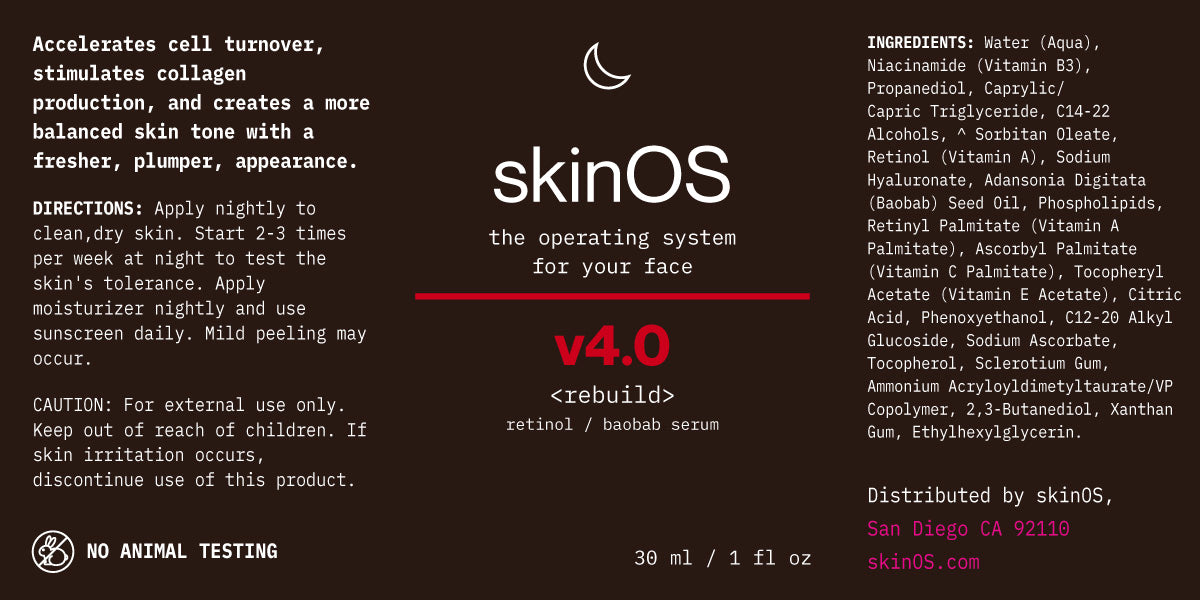
Step 2: Rebuild. This is retinol’s slot. Apply it to clean, dry skin. Retinol needs a slightly acidic pH to penetrate effectively, which is why it goes on bare skin after cleansing (your cleanser maintains the skin’s natural pH of ~5.5). Four to five drops of serum, patted into the face and neck. Avoid the eye area if you’re new to retinol (the skin there is thinner and more reactive). About 10 seconds.
Why retinol at night and not in the morning? Two reasons. First, retinol is photosensitive. It degrades when exposed to UV light, which means a significant portion of its activity is lost during the day. Applying it at night gives it a full 6–8 hour window to work without UV interference. Second, retinol increases your skin’s sensitivity to UV for a period after application. Using it at night means the increased sensitivity occurs while you’re indoors. By morning, you cover the residual sensitivity with your SPF layer.
Step 3: Recover. Apply a recovery cream or night cream over the retinol. This step does two things. It creates an occlusive layer that prevents the retinol from evaporating and keeps it in contact with your skin longer. And it delivers barrier-repairing ingredients (ceramides, fatty acids, niacinamide) that restore the skin overnight. About 10 seconds. Done.
That’s the night. Clean, rebuild, recover. Three actions. 90 seconds. You do it after you brush your teeth before bed. Same window as the morning, different products, different jobs.
The Shared Step
You’ll notice the cleanser appears in both routines. It’s the only product used twice daily. This isn’t redundancy. The morning cleanse and the evening cleanse serve different purposes (removing overnight buildup vs. removing daytime accumulation), but they both require the same thing: a gentle, pH-balanced cleanser that prepares the surface without damaging the barrier.
This is also why the cleanser is the most important product in the system from a frequency standpoint. You interact with it more than anything else. If it’s too harsh, you’re damaging your barrier twice a day. If it’s properly formulated, you’re resetting the surface twice a day and giving every other product the clean canvas it needs.
What Not to Mix
Most of the five ingredients we discussed play well together. But there are a few combinations to be aware of:
Retinol + vitamin C: use them at different times. Both are active, both are pH-sensitive, and using them simultaneously can cause irritation in some people. The simplest solution is vitamin C in the morning (where it does its antioxidant work) and retinol at night (where it does its collagen work). Problem solved.
Retinol + AHAs/BHAs: be cautious. If you use a chemical exfoliant (glycolic acid, salicylic acid), don’t use it on the same night as retinol. Both accelerate cell turnover and using them together can over-exfoliate, leading to irritation and barrier damage. Alternate nights if you use both.
Niacinamide + everything: it’s fine. Niacinamide is one of the most compatible ingredients in skincare. It works alongside retinol (reduces its irritation potential), alongside vitamin C (despite an old myth that they conflict, modern formulations are stable together), and alongside hyaluronic acid. It’s the easiest ingredient to integrate.
The 90-Second Test
Here’s a useful heuristic: if your skincare routine takes more than 90 seconds per session, it’s probably more complicated than it needs to be.
A 12-step routine isn’t more effective than a 3-step routine if the 3 steps contain the right ingredients at the right concentrations in the right order. The additional steps in a longer routine are typically either redundant (two products doing the same job), unnecessary (ingredients without clinical evidence), or counterproductive (too many actives competing for absorption).
Three steps. 90 seconds. Morning and night. That’s the target. If your routine exceeds that, audit each step and ask: what is this product doing that my other products aren’t? If you can’t answer clearly, it probably doesn’t need to be there.
Where This Leaves You
Over the last six chapters, you’ve gone from “the skincare industry is confusing” to understanding exactly how your skin ages, what’s breaking down, which ingredients reverse or prevent it, and in what order to use them.
That’s the education. And for some readers, it’s enough. You could take what you’ve learned and go build your own routine from individual products. Research each ingredient. Compare brands. Check concentrations. Read reviews. Find five products that work together.
But here’s the honest question: are you going to do that?
Most men won’t. Not because they’re lazy, but because the research takes hours, the trial and error takes months, and the whole reason you ended up on this page is that you wanted someone to cut through the noise and just tell you what to do.
In the next chapter, we’re going to show you what it looks like when someone already did.
─────────────────────────────
NEXT CHAPTER
Chapter 7: The System: What If Someone Already Figured This Out? →
LAST CHAPTER: